
In today’s digital commerce landscape, fraudsters continuously look for gaps in checkout workflows to exploit. While much attention is given to shipping addresses, IP geolocation and payment verification, billing details are often underutilized as a fraud detection signal. This is where Bill To Validation becomes a powerful addition to your fraud prevention strategy.
Bill To Validation refers to the process of verifying and analyzing the billing entity information provided during checkout. Instead of focusing solely on card numbers or billing addresses, it examines the actual billing name or company associated with the transaction. By validating this information against predefined rules, merchants can detect suspicious patterns, block high-risk transactions and reduce chargebacks.
Why Bill To Information Matters
In B2B transactions, corporate purchases and even certain B2C scenarios, the “Bill To” field often contains a company name or billing entity that differs from the shipping recipient. Fraudsters may:
- Use fake or disposable company names
- Impersonate legitimate businesses
- Input inconsistent billing identities across multiple transactions
Without validating the Bill To field, these anomalies can go unnoticed. For example, a fraudster might ship goods to a residential address but list a well-known corporation in the billing field to appear legitimate. Alternatively, repeated use of slightly altered company names may indicate automated fraud attempts. Bill To Validation adds another verification layer to detect such inconsistencies.
The New bill_to Field in the Screen Order API
To strengthen fraud analysis capabilities, FraudLabs Pro introduced a new input parameter called bill_to in its Screen Order API. This field allows merchants to submit billing entity information directly during fraud screening. The bill_to field is designed to capture Company name, Business entity name and Organization billing reference. By sending this data to the fraud detection engine, merchants enable more precise rule-based validation and pattern analysis.
Benefits of Bill To Validation
There are several benefits of Bill To Validation that help merchants strengthen fraud screening:
- Enhanced Fraud Detection Signals: Billing entity data provides an additional behavioral indicator beyond payment and shipping details.
- Better B2B Risk Control: For merchants serving corporate clients, validating company names helps ensure purchases align with authorized business entities.
- Improved Order Review Efficiency: By automatically filtering based on Bill To rules, manual review teams can focus only on genuinely high-risk cases.
New Validation Rule
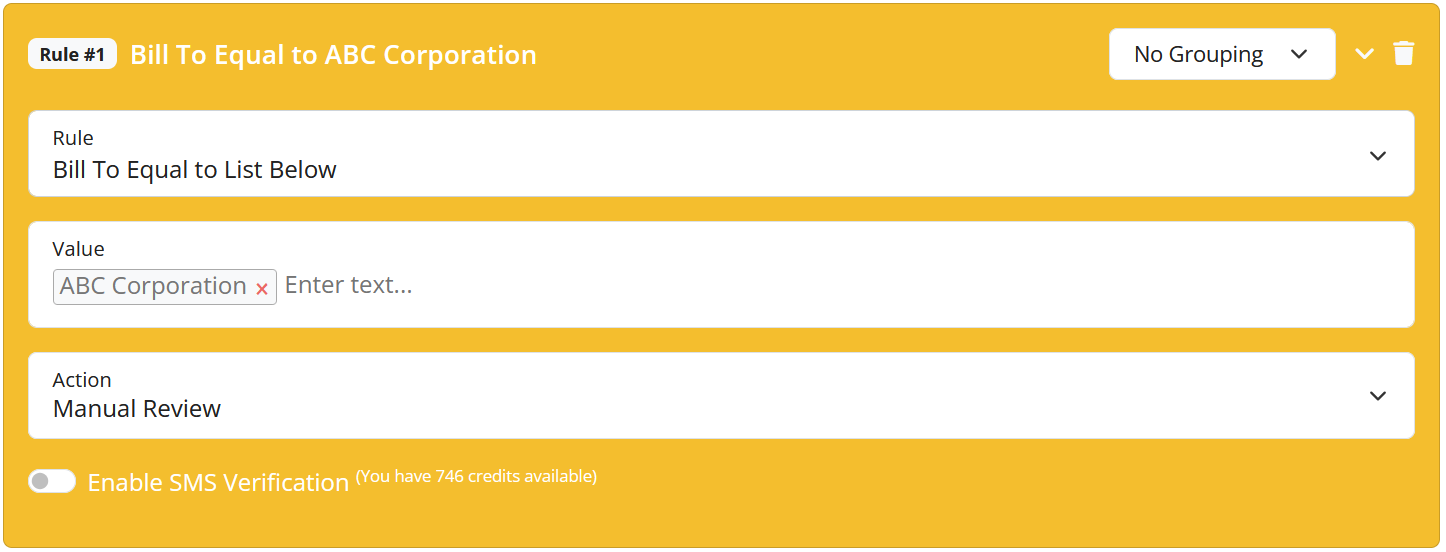
FraudLabs Pro has introduced a new validation rule called: Bill To Equal/Not Equal to List Below. This rule verifies the Bill To value against a predefined list using an exact, case-insensitive match. Merchants can configure the system to either:
- Flag orders when the Bill To exactly matches entries in the list or
- Flag orders when the Bill To does not match entries in the list
This rule is accessible on the Rules Management page and is available exclusively to merchants subscribed to the Medium plan or higher.
Conclusion
Fraud prevention is most effective when multiple data points work together. Shipping address checks, IP analysis, device fingerprinting and payment verification all play critical roles. Adding Bill To Validation enhances this ecosystem by introducing an additional layer focused on billing entity intelligence.